
The Innovation Age
Leading the companies that will build our future
will AI create a new species of company?
The Geneology of the Modern Company
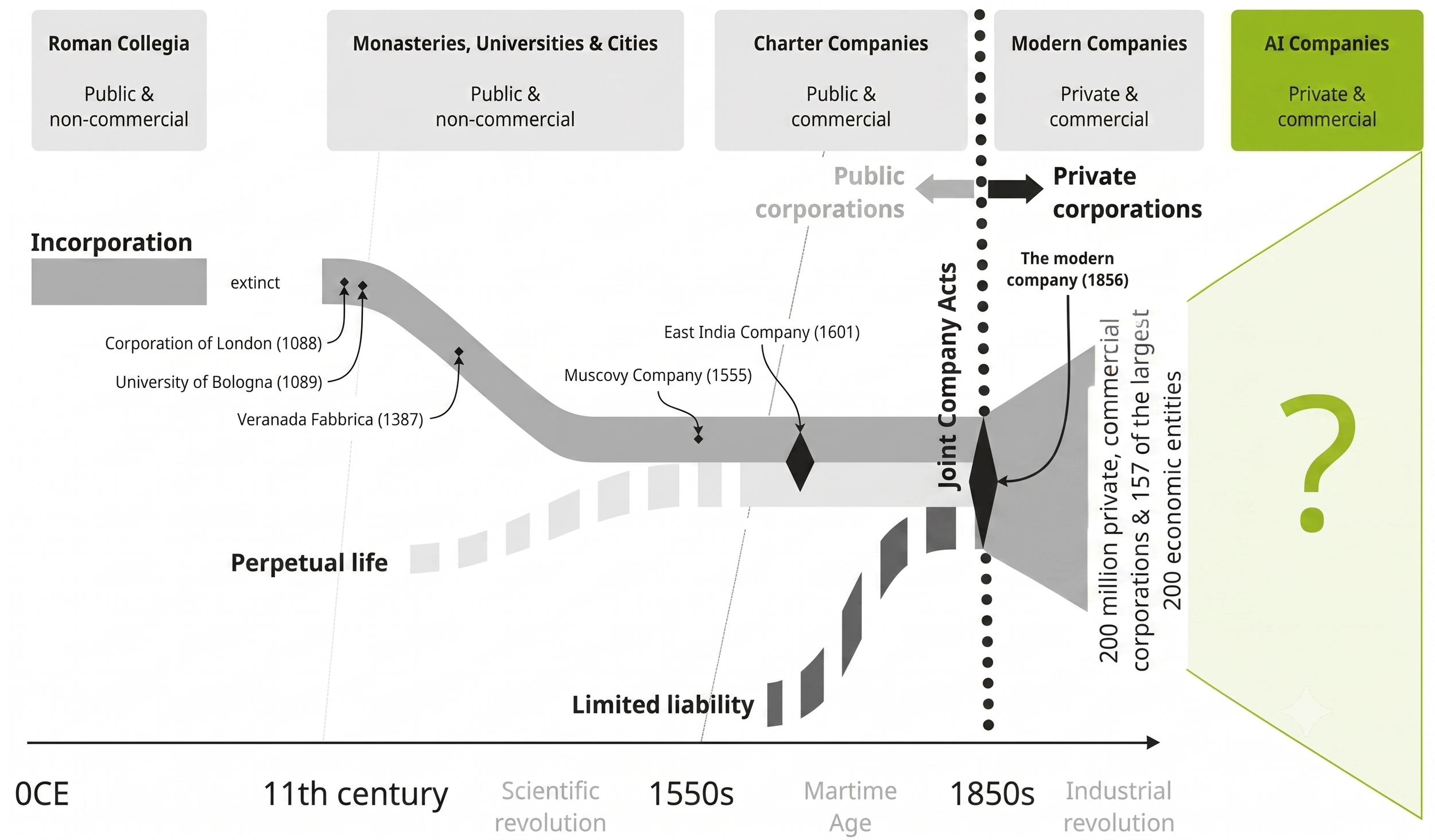
AI and the companies of the future
How must companies adapt to accommodate a world in which billions of autonomous AI Agents engage with each other - both inside and outside the firm - in an attempt - we hope! - to deliver on the needs of their human owners?
Today, most AI developers believe that once AI agents reach ‘super-intelligence’, the ‘problem of cooperation’ simply disappears. After all, if an AI agent can solve Fermat’s theorem, surely it will find working cooperatively with others simple. Current evidence, however, suggests otherwise. When AI Agents play Publics Goods Game in which they are charged with managing a virtual fishing lake, most agents die after just two rounds of a twenty round game, with the more recent, more ‘rational’ LLMs performing worst. Rationality does not entail cooperation, and indeed - as the history of human free-riders has shown - it may actually undermine it!
Overcoming AI’s current self-interested transactionalism requires creating for AI agents an institutional environment comparable to the law courts, prisons, and churches that have sustained large-scale human cooperation for the last ten thousand years. These synthetic institutions must include a ‘digital constitution’, which would need to be cryptographically signed by all AI agents and which, if breached, would result in the agent being ‘blacklisted’ or ‘deprovisioned’. They must include a ‘public reputation ledger’, so that everyone can track an agent’s past behaviour to decide whether or not to trust them. They must include a ‘smart contracts system’ which captures promises between agents and would automatically trigger the appropriate sanctions if breached. And finally, they must include a ‘digital magistrate’ who could arbitrate disputes and impose substantive penalties in order to ensure that the wheels of this new AI agent economy kept spinning.
The company’s history has been building the institutional scaffolding that facilitates large-scale cooperation between humans; the company’s future must now be to extend this scaffolding to facilitate large-scale cooperation between AI agents.