

The Innovation Age
Leading the companies that will build our future
Why are teams, communities and brains modular?
The explosion of Europe’s collective brain
The Magic of Modularity
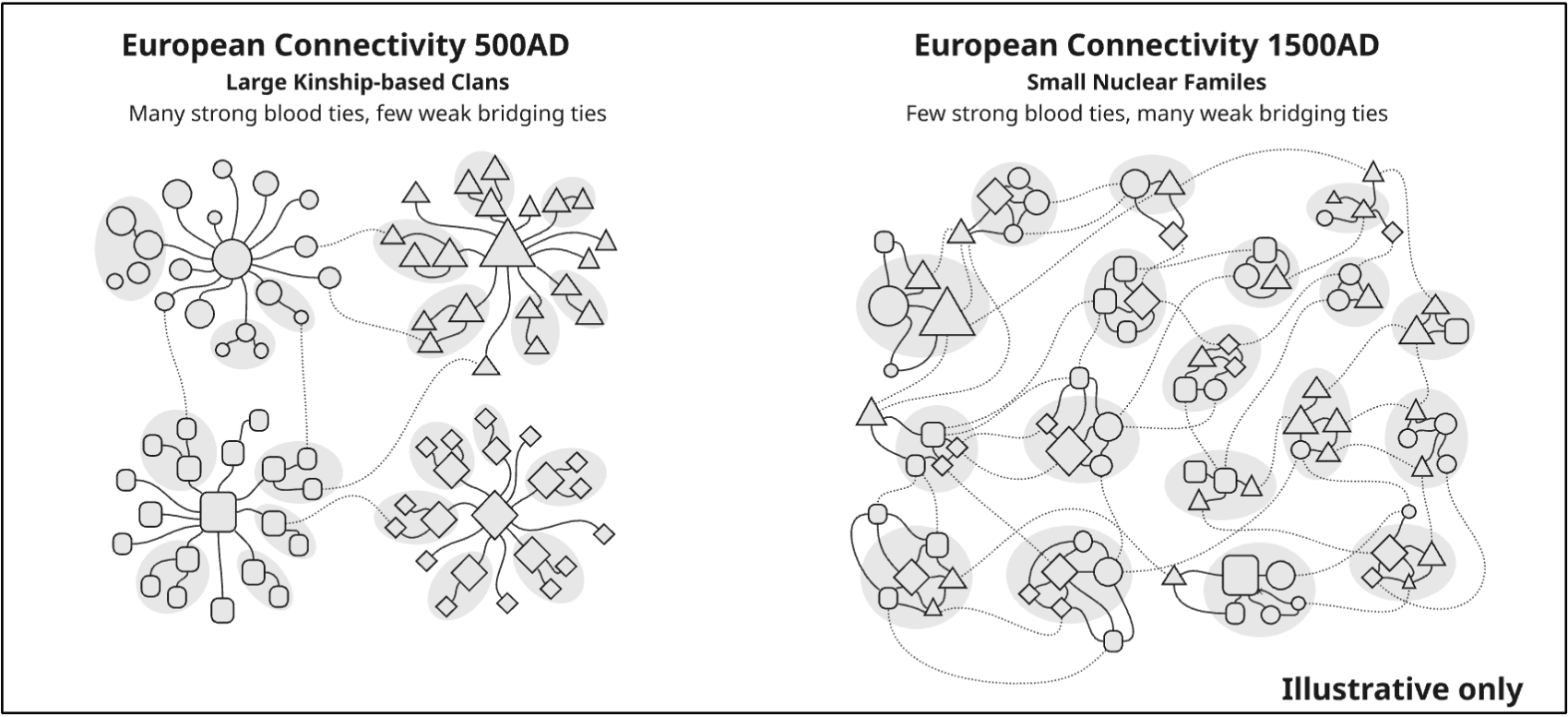
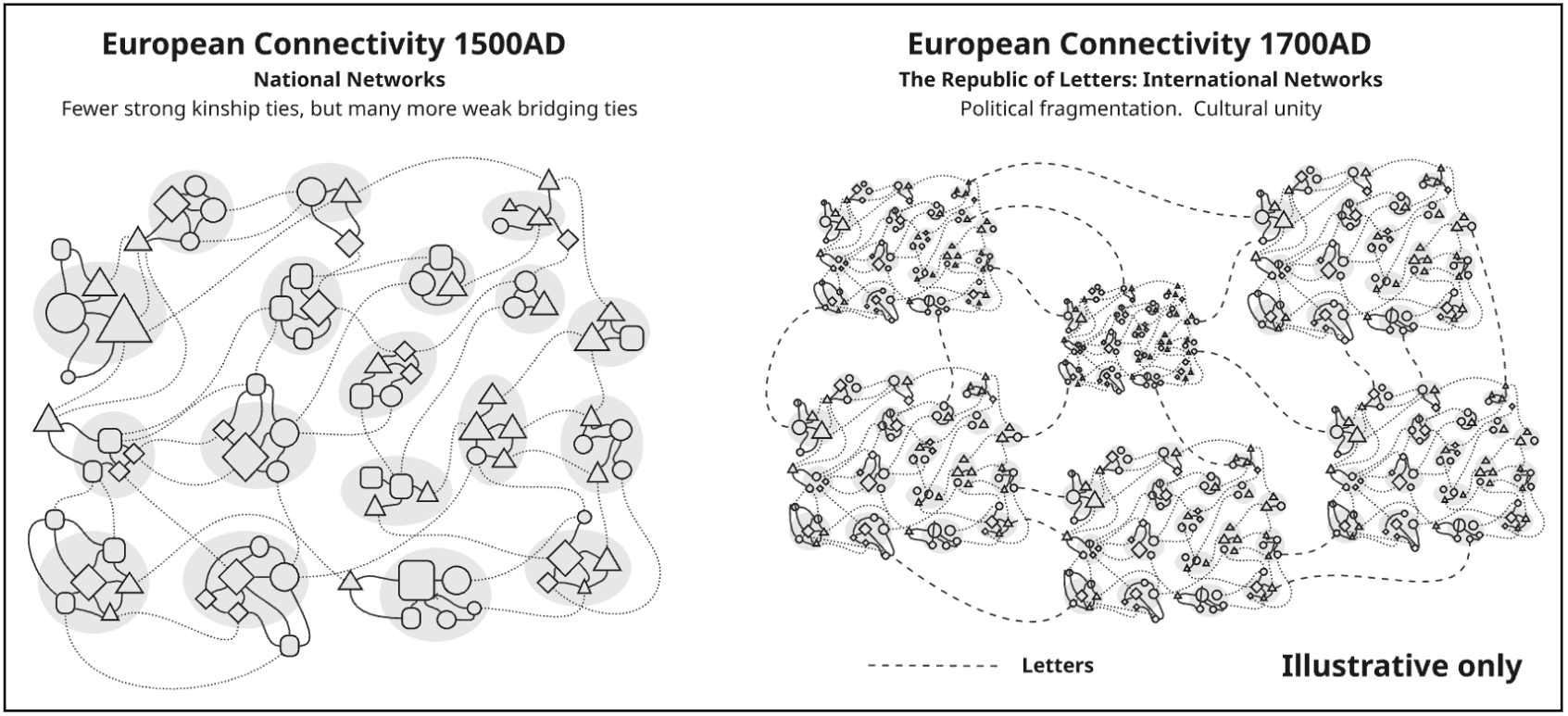
Modules matter because how the groups within a community are organised determines who connects with whom. This impacts the information you receive, which in turn shapes how you see the world. Families provide the strong connections that nurture, sustain, and protect, but, as families tend to be insular and to share the same values, they are rarely sources of new information. Instead, it is the weaker, inter-modular connections we form with associates, or even with strangers, that provide us with novel information about the world. Families protect, associates inform.
Modules matter the most in large complex systems as the structures and behaviours of the whole emerge bottom-up from the attributes of its component parts. Unlike a house, complex systems do not have a single architect. Instead, the patterns that emerge at one level are the result of changes in the levels below.
The Scientific and Industrial Revolutions occurred in Europe because between 500 to 1700AD the Church and the printing press jointly caused a reorganising of society. The Catholic Church’s war against inter-cousin marriage broke apart Europe’s previously most important social module - the kinship-based clan - and gave rise to a new module - the nuclear family - which, shorn of its previous commitments, set about constructing a new set of ‘weak’ associations. And the printing press, together with Europe’s postal system, its common Latin language, and its shared belief that knowledge should be free and used in the service of the common good, provided the connective tissue that allowed new ideas to flow in all directions, expanding Europe’s collective brain.
Modular systems are everywhere: neighbourhoods, are the key building block of any vibrant city; local government, is key building block of any representative democracy; and companies, are the building blocks of our economy.
To understand why modular structures keep reemerging across such a wide range of environments and why modularity is so important to innovation, we need to dive deeper into what modularity is and why it is such a powerful way of organising things. And then, we need to then understand why, given modularity’s magic powers, so few companies are structured modularly.